Skip to content
Kitchen6 min read

PET bottles: recyclable on paper, mostly not in practice

PET is the 'good' plastic — clear, lightweight, kerbside-accepted. The number that matters is how much of it actually becomes a new bottle. It is small.
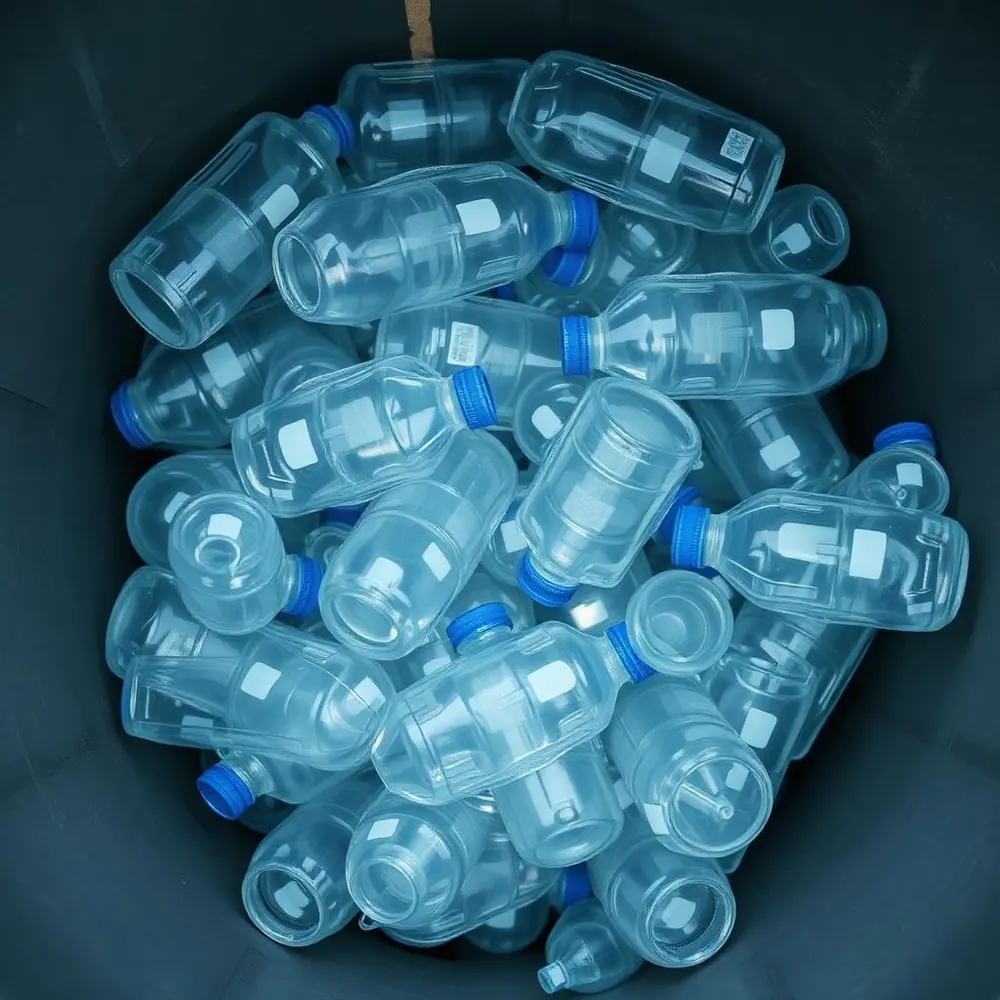
Clear PET water bottles with blue caps collected inside a recycling bin, top-down view.

Polyethylene terephthalate — PET, resin code #1 — is the polymer that built the modern bottled-drinks aisle. It is clear, lightweight, food-safe, and unlike most plastics it is genuinely accepted at kerbside collection in almost every developed country. So a reasonable person looks at a PET bottle, sees the recycling triangle, and assumes the system handles it. The system mostly does not.

The recycling-rate gap

Global collection of PET bottles sits at roughly 50%. That number alone sounds tolerable. The number that matters is bottle-to-bottle: PET collected, sorted, washed, depolymerised, and turned back into a new food-grade bottle. That figure is closer to 9%. The remaining 41% of collected PET is downcycled into polyester fibre or single-use trays — a one-way trip that ends in landfill within a year or two.

Downcycling is not recycling

  • Bottle → polyester clothing — sheds microfibres for the rest of its life, then lands in textile waste with no further recycling path.
  • Bottle → thermoformed tray — too contaminated and too thin to re-enter the bottle stream; binned after one use.
  • Bottle → carpet backing — the terminal use. Carpet is not recycled at scale anywhere.

Calling any of this 'recycling' is a stretch the industry has been allowed to make for thirty years. It is a delay of disposal, not a cancellation of it.

Microplastics and antimony

PET is more stable than soft plastics, but it is not inert. Bottles shed measurable microplastic particles into their contents — more when warm, more when reused, more when sun-exposed in transport. PET also leaches trace antimony, a catalyst residue from its manufacture; concentrations stay below regulatory limits in fresh product but rise with heat and time. None of this makes PET acutely dangerous. It does make the 'just rinse and reuse' advice questionable.

Where PET still earns its place

There are real contexts where refill is not on the table: hospital fluids, disaster relief, long-haul travel through regions without potable water. In those cases PET is genuinely the right answer — lighter than glass, safer than PVC, lower-carbon than aluminium per unit. The mistake is treating that narrow case as a licence for the supermarket aisle.

Recyclable is a property of the material. Recycled is a property of the system. The first one is on the bottle; the second one almost never happens.

The honest hierarchy

  • Refill from tap, filter, or local refill point — first choice, by a wide margin.
  • A reusable stainless or glass bottle carried daily — pays back its embedded footprint inside two months.
  • PET as a genuine last resort — and when you use one, put it in the kerbside bin clean, capped, and uncrushed so it has its best shot at the small bottle-to-bottle stream.

PET recycling facts at a glance

  • Resin code: #1 PET / PETE — accepted by virtually every kerbside programme worldwide.
  • Global collection rate: ~50% of bottles sold; bottle-to-bottle recycling: ~9%.
  • Recycled content in new PET bottles: ~6% global average, ~17% in the EU (2023).
  • Energy to recycle vs make virgin PET: ~75% less; CO₂e: ~70% lower per kg.
  • Caps and labels: modern MRFs sort these — leave the cap on, leave the label attached.
  • Colour matters: clear PET is the most valuable; green and opaque white are usually downcycled.
  • One contaminated bottle does not ruin a bale, but oil, solvent, or pesticide residue can — those go in general waste.

Disposing of PET where you live

Kerbside rules vary more than the recycling triangle suggests. A 60-second check on your local council or municipal website is the difference between a bottle that gets sorted and one that gets landfilled as contamination. The shape of the guidance is broadly consistent across regions:

  • UK — almost all councils accept PET bottles in the mixed-recycling bin. Rinse, squash lengthways, replace the cap. Check Recycle Now's postcode locator for anything non-bottle (trays, punnets).
  • EU — deposit return schemes (Germany, Netherlands, Ireland, Romania, Slovakia, parts of Spain) pay 10–25¢ per bottle and feed the bottle-to-bottle stream directly. Use the DRS first; kerbside second.
  • United States — only ten states run deposit schemes; elsewhere PET goes in the single-stream cart. Earth911's zip-code search lists local drop-offs for items the kerbside cart refuses.
  • Australia and New Zealand — every state and territory now runs a Container Deposit Scheme (10¢ per eligible container). Non-deposit PET goes in the yellow-lid bin.
  • Canada — provincial deposit schemes cover most PET drink bottles; non-deposit containers go in the blue bin.
  • Anywhere with no kerbside collection — supermarkets, refill shops, and some workplaces run take-back points. A quick search for 'PET bottle drop-off near me' usually finds one within a few kilometres.

Two universal rules wherever you are: empty and rinse so the bottle is not a food source for the sorting line, and never bag your recyclables — bagged loads are routinely diverted straight to landfill because MRFs cannot open them safely.

Sources

  1. PET Life Cycle Assessment Report 2023NAPCOR (National Association for PET Container Resources) · 2023 · NAPCOR
  2. Meta-Analysis of Life Cycle Assessment Studies for Polyethylene Terephthalate Water Bottle SystemGo, Y.-J., Kang, D.-H., Park, H.-J., Lee, J.-H. & Shim, J.-K. · 2024 · Sustainability
  3. Single-use plastic bottles and their alternatives — Recommendations from LCAUnited Nations Environment Programme / Life Cycle Initiative · 2020 · UNEP
  4. Open-loop recycling: A LCA case study of PET bottle-to-fibre recyclingShen, L., Worrell, E. & Patel, M. K. · 2010 · Resources, Conservation and Recycling
  5. Antimony leaching from polyethylene terephthalate (PET) plastic used for bottled drinking waterWesterhoff, P., Prapaipong, P., Shock, E. & Hillaireau, A. · 2008 · Water Research
  6. Regulation (EU) 2025/40 on packaging and packaging waste (PPWR)European Parliament and Council · 2025 · EUR-Lex
The journal, in your inbox

One short letter a month. No noise, just measurements.

New audits, fresh swaps, and the occasional graph that surprised even us. Unsubscribe whenever you like.